Show me your data—not just your sleek pitch deck, Your methods, your dictionary, the systems you’ve built. Your coverage and demographics laid bare, not kept in check.
Show me your data—don’t hide behind proprietary walls. Indulge me in your inclusion and exclusion criteria. Publish the methods, share the code, give the “how” behind the “whoa!”
Show me your data—a simple Table 1 would do, and perhaps you could throw in a Figure 1 flowchart too. What corpus trained your model? What metric forestalls your errors? How do you validate—internally or externally?
Show me your data—what does your missingness reveal? How do you handle the gaps where information should be? Can you acknowledge your biases with candour, not conceal the limitations that shape your algorithmic prophecy?
If you truly are the best—as your marketing claims, If you provide immense value and genuinely care about the populations you serve (yes, serve, not just aim to profit from), Then, publishing research should feel fair.
Show me your data—a simple request, nothing grand. Share methods, share learnings, build bridges of trust. For all your AI promises and future so planned, Until transparent beats opaque, “AI for good” is just a take.
Show me your data. An ode to organizations building health apps, wearables, advanced analytics and AI. In a world where algorithms increasingly shape healthcare decisions. This is a call for transparency from those who build the tools that influence health and how care is delivered.
Building trust is fundamental to any relationship, whether in business, friendship, or romance. But how do we transition from knowing very little about someone to trusting them implicitly?
How do we reach a point where we’re willing to invest our resources, time, and networks into their vision and goals, or even consider creating a shared future?
One effective method involves creating an environment for open, candid, and vulnerable communication. A technique known as Mono-dialogue + Eye-gazing offers a powerful way to foster a deeper connection between partners.
What is Mono-dialogue + Eye-gazing?
Mono-dialogue + Eye-gazing is a practice rooted in active and reflective listening. I encountered this technique while studying tantra and yoga in Ecuador. Unlike many listening exercises, this practice focuses solely on providing a space for the speaker to express themselves. The listener’s role is to be fully present and absorb what is shared, without needing to respond or restate anything.
An exercise in being true to oneself and in relation to others.
The Purpose and Protocol
The purpose of Mono-dialogue + Eye-gazing is to speak uninterrupted about whatever is on one’s mind, flowing directly from mind and spirit into words, to allow a raw and unfiltered communication of emotions, thoughts, etc., while the other person listens and absorbs without interfering with the flow.
Setup: Sit across from your partner and make direct eye contact. Time & Requirements: 1-2 hours; 2 individuals; in-person (preferred).
Become Present and Grounded: Close your eyes, take a deep breath, and slowly release it. Repeat this grounding process 3-5 times.
Eye-gazing: Spend 5 minutes silently making eye contact with your partner. This helps establish a deeper interpersonal connection.
Sharing – Person 1: Person 1 (P1) asks Person 2 (P2) for consent to share. Once consent is given, P1 speaks uninterrupted for 15 minutes. P2 listens attentively without speaking or reacting.
Sharing – Person 2: The roles are reversed. P2 now takes 15 minutes to share their thoughts, while P1 remains the listener. Repeat Sharing Cycle: Engage in at least 1-3 more rounds of sharing, with both partners alternating roles. After each round, take a moment to close your eyes, breathe, and center yourselves.
Closing: Dedicate 5 minutes to thanking each other for sharing and listening. If both are comfortable, reflect on your experience and discuss what you’ve learned or are curious about.
Tips and Enhancements
Embrace discomfort; speaking for an extended time can trigger various emotions.
Topics are flexible; share whatever feels right to you.
Neither person is not obligated (but they may choose) to reply or acknowledge anything said by the other individual during their time of sharing.
Consider adjusting the sharing time to 20-minute periods.
Limit the exercise to a maximum of 2 hours.
Determine the sharing order using methods like flipping a coin or rock-paper-scissors.
Engaging in Mono-dialogue + Eye-gazing can be a transformative experience, deepening the connection and trust between partners. Whether you’re looking to enhance your business relationships or foster stronger personal bonds, this practice offers a unique way to build understanding, empathy, and trust.
Defining Health is a glossary of sorts filled with definitions and abbreviations used across the health and wellness industries in hopes to help build better common language.
Definitions and abbreviations are listed alphabetically with link provided with additional details and their source. This list is updated regularly with the acknowledgement that definitions change, what we know today may not be what we know tomorrow, and words/abbreviations can have many meanings. Enjoy and please feel free to provide feedback, questions and request words/abbreviations to explore.
Anthroposophic Medicine – An integrative multimodal treatment system based on a holistic understanding of man and nature and of disease and treatment. It builds on a concept of four levels of formative forces and on the model of a three-fold human constitution. It is integrated with conventional medicine in large hospitals and medical practices. It applies medicines derived from plants, minerals, and animals; art therapy, eurythmy therapy, and rhythmical massage; counseling; psychotherapy; and specific nursing techniques such as external embrocation. Anthroposophic healthcare is provided by medical doctors, therapists, and nurses. Kienle et al. 2013
Anthroposophy – i) View on humanity and nature that is spiritual and that at the same time regards itself to be profoundly scientific. Kienle et al. 2013 ii) The “consciousness of one’s true humanity” and is intended to be a way that “leads what is spiritual in the human being to what is spiritual in the universe.” Bartelme 2017
Autogenic training (AT) – A relaxation technique developed by German psychiatrist Johannes Heinrich Schultz and was first published in 1932. AT is designed to support self-generating or self-regulatory mechanisms for counteracting the effects of stress. It has been widely used in clinical practice and research to foster the mind’s ability to produce relaxation in the body. Shapiro & Lehrer 1980 & VA Office of Patient Centered Care and Cultural Transformation Accessed 10/2023
Biocultural Medical Anthropology – Strives to understand why people grow and develop as they do and why they may be at risk for health problems. It explores the nexus between culture and human biology and examines human genotypic and behavioral plasticity in context. It investigates short- and long-term health outcomes that result from changing and differential access to resources (e.g., stunted growth and development due to malnutrition and poor survivorship resulting from limited access to primary health care), differential exposure to environmental stressors (e.g., from exposure to pollution to exposure to the stresses of poverty, overcrowding, fear of hunger, violence, and oppression), and the cultural practices and social institutions that mediate the effect of these stressors. A biocultural approach focuses on what is cultural about biosocial relations. McMahan & Nichter 2011
Biopiracy – The unauthorized extraction of biological resources and/or associated traditional knowledge from developing countries, or the patenting of spurious inventions based on such knowledge or resources without compensation. First coined by the Canadian activist group Rural Advancement Foundation International (RAFI). Imran et al. 2021 & Neimark 2017
Communities of Practice – Groups of people who share a concern or a passion for something they do and learn how to do it better as they interact regularly. Coined by Drs. Jean Lave and Etienne Wenger-Trayner, a Community of Practice (CoP) has three defining characteristics: 1) Domain: CoP members share a commitment to the domain and a collective understanding of each other’s competencies and basic understanding of their shared concern or passion. 2) Community: CoP members engage in joint activities wherein they learn how to improve their similar programs, share best practices, and discuss areas of growth. These joint activities are foundational for building the “community” in a Community of Practice. 3) Practice: CoP are practitioners; they develop a shared repertoire of resources: experiences, stories, tools, ways of addressing recurring problems—in short a shared practice. Wenger-Trayner 2015 & UC Davis Center for Diverse Healthcare Workforce accessed 10/2023.
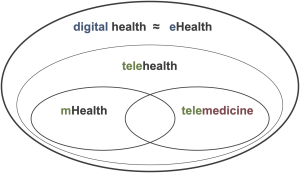
Digital Health – i) the convergence of science and technology with health, health care, living, and society. Bhavnani et al. 2016 ii) the use of information technology and electronic communication tools within the delivery of healthcare services. Burrell et al. 2022
Ecofascism – i) A reactionary and revolutionary ideology that champions the regeneration of an imagined community through a return to a romanticised, ethnopluralist vision of the natural order. It is suggested that ecofascism is a subform of fascism, not an equal merger of fascism and ecologism. Campion 2023 ii) Any environmentalism that advocates or accepts violence and does so in a way that reinforces existing systems of inequality or targets certain people while leaving others untouched. It is basically environmentalism that suggests that certain people are naturally and exclusively entitled to control and enjoy environmental resources. Some types of people, in other words, are “native species” and others are “invasive.” Hancock 2022 – UConn Communications. Accessed 11/2023
Emic View – The perspective of a member of the culture being studied, an indigenous approach to data collection; research that fully studies one culture with no (or only a secondary) cross-cultural focus. Explores a particular psychological construct from within the culture. With the emic approach, instruments and theories indigenous to the target culture are developed by relying on a systematic process (through psycholexical studies, focus groups, interviews, content analyses of popular media, or culturally informed traditional scale development methods) that generates a set of local or “indigenous” attributes and stimuli. Benet-Martínez 2021, Fetvadjiev & van de Vijver 2015
Etic View – The perspective of an outsider looking in. An imported approach to data collection; research that studies cross-cultural differences. An imposed-etic approach, which is the most commonly used one, typically involves the use of translated instruments that were originally developed in another language and cultural context. Typically involves the use of translated instruments that were originally developed in another language and cultural context. Benet-Martínez 2021, Fetvadjiev & van de Vijver 2015
Ethnomedicine – i) The study of natural resources traditionally used to cure or manage ailments in diverse ethnic culture. Scientifically, the study of “traditional medicine” of ethnic communities, their knowledge and practices that transmitted orally over centuries, and evolved over millennia of human existence. Mahapatra et al. 2019 ii) Area of anthropology that studies different societies’ notion of health and illness, including how people think and how people act about wellbeing and healing (healthcare or just treatment). Medicine – like language, music and politics – is a subset of culture which is situated locally. Jirata 2017
Health – i) State of complete physical, mental and social well-being and not merely the absence of disease or infirmity. Constitution of the WHO. Accessed 11/2023 ii) To reach a state of complete physical, mental and social well-being, an individual or group must be able to identify and to realize aspirations, to satisfy needs, and to change or cope with the environment. Health is, therefore, seen as a resource for everyday life, not the objective of living. The Ottawa Charter for Health Promotion. Accessed 11/2023
Humanics – The study of the human nature. Williams 1954
Indigeneity – A broad, working definition of Indigeneity is that it is a quality of a person’s and a group’s identity that links them to specific places with knowledge of and respect for original ways. One need not identify as Indigenous to work within a framework of Indigeneity. In fact, respect for Indigenous sovereignty requires those who are not Indigenous to understand that Indigenous people have specific protocols and preferences for identifying as Indigenous and for sharing knowledge. Of course, Indigenous people whose identities are not original to the place where they reside are just as responsible for understanding those protocols as non-Indigenous people are. – Emory University, Accessed 9/2023
De-implementation – Discontinuing or abandoning practices that are not proven to be effective, are less effective or less cost-effective than an alternative practice, or are potentially harmful, overused or inappropriate. Walsh-Bailey et al. 2021 & Prusaczyk et al. 2020
Integrative Medicine – the practice of medicine in a way that selectively incorporates elements of complementary and alternative medicine into comprehensive treatment plans alongside solidly orthodox methods of diagnosis and treatment. Its focus being on health and healing rather than disease and treatment. It views patients as whole people with minds and spirits as well as bodies and includes these dimensions into diagnosis and treatment. It also involves patients and doctors working to maintain health by paying attention to lifestyle factors such as diet, exercise, quality of rest and sleep, and the nature of relationships. Rees & Weil 2001
Medical Anthropology – Combing the emic perspective of ethnomedicine with the etic measure of bioscience. 1) Identifies the health problems and how it is conceivably healed according to locals. 2) Objectively assess the remedy’s ability to produce emically desired effects. 3) Identifies the areas of convergence and divergence between the emic and etic assessment. [Browner et al. 1988]
Medical Pluralism– Coexistence of differing medical traditions and practices grounded in divergent epistemological positions and based on distinctive world views. The availability of different medical approaches, treatments and institution that people can use while pursuing health. Existence of multiple medical systems in a given society.
Primary Determinants of Health – Includes the social, economic and physical environments and the person’s individual characteristics and behaviors. The maintenance and improvements of health, accordingly, depends not only on external or environmental factors (including systems of care), but also on the efforts and intelligent life style choices of the person, in fact it depends on wellness.
Salutogenesis – A model of health which focuses on the factors that promote physical and mental well-being rather than those that cause disease. Related to health promotion and preventive medicine. In a nutshell: Disease prevention focuses on minimizing health risk factors and health promotion focuses on maximizing healthful behaviors. Salutogenesis focuses on the resources that move people toward overall well-being, even during stressful times. – Psychology Today accessed 2023, Mittelmark & Bauer 2016.
Syndemic Theory – Focuses on the adverse interactions between diseases and social conditions (co-morbidities) specifically drawing attention to the mechanisms of these interactions. Identification of syndemic interactions allow for a new way of understanding the prevention and treatment of the involved conditions.
Wellness – An active process through which people become aware of, and make choices toward a more successful existence. 1) Conscious, self directed and evolving process of achieving full potential. 2) Multidimensional and holistic, encompassing lifestyle, mental and spiritual wellbeing and the environment 3) Positive and affirming [Stoewan 2015, CANVET J]
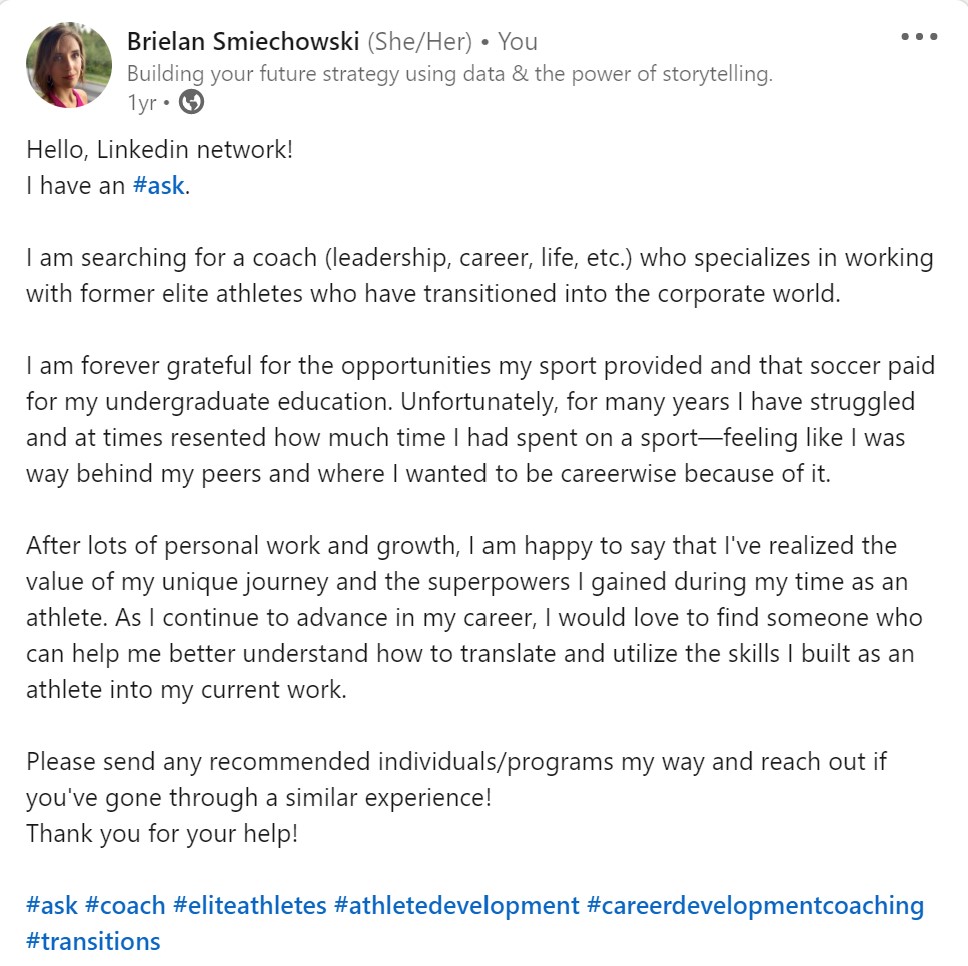
A year ago, I asked my network for recommendations on coaches specializing in elite athletes and transitions.
I had a few responses but nothing really hit what I was looking for and ended up going on an exploration to find the practices, tools and guidance I was seeking. Here’s what I’ve discovered so far (will update overtime):
Athlete Soul– an independent support solution for retiring athletes. Their mission is to support athletes as they transition away from sports, raise awareness about the challenges of athletic retirement, and empower athletes to develop beyond sports. They support athletes before, during and after their transition with educational resources, transition and career coaching, and networking opportunities.
I had the pleasure of attending this year’s HLTH event in Las Vegas on Nov. 13-16, 2022.
#hlth2022 was the first time I had experienced an event at this scale with attendees that included more than just traditional healthcare/biotech players and investors. Attendance also included tech, consumer-focused wellness, and at a smaller capacity – patients and non-profits.
I congratulate the HLTH team for creating an event that acknowledges how we approach health is changing and that the tools and systems necessary to allow everyone the opportunity to be healthy goes beyond what health insurance traditionally covers. I hope the conversations at HLTH lead to more common language and openness for alignment on the scientific rigour necessary for a consumer product to be taken seriously by traditional health players.
Connecting key health stakeholders from diverse backgrounds is a significant step in the right direction, redefining what is considered “healthcare” and who pays for what is needed. Although consumer and retail products have value, affordability is still an issue, especially if payers are not considering these offerings for reimbursement. Many valuable solutions may never reach those who need them most due to the inability to pay out of pocket.
Further, more efforts are required to help improve benefits communication, patient and caregiver education, benefits communication, and guidance around coordinating whole health care. As discussed during the Sexual Healing panel – language matters – we need to meet individuals where they are. Creating complicated reimbursement schemes or unclear patient pathways further deters the engagement of high-need but historically marginalized individuals.
Reimaging healthcare requires greater awareness and more conversations around the inequities and barriers to access that exist to being healthy. I was happy to hear many talks at HTLH discuss inclusion, health equity and social determinants of health (SDOH). However, I found that much of the heavy lifting and progress around these initiatives still comes from female and minority-led start-ups, non-profits and government. Big healthcare, life sciences and tech need to step up and better support efforts through partnerships, acquisitions, and funding versus building lacklustre duplicates or “check the box on DEI” solutions.
For start-ups and capital providers, HTLH also confirmed that a course correction in funding is occurring. Although many blame COVID for creating a funding ecosystem that led to waste and significantly overvalued start-ups, this trend was already apparent in mid-2019. COVID only added fuel to this unfortunate trend.
I stepped away from consulting with digital health start-ups at the end of 2019 due to my frustration of encountering many organizations that had raised significant funds but were not incentivized or interested in genuinely moving the needle in healthcare. Instead, many start-ups chose to take the consumer route to hit early funding milestones. At this time, I opted to join Veeva for 2 years, a rare example of a Healthtech start-up that raised minimal cash ($7M total) and reached $1 billion in yearly revenue within thirteen years of its inception.
Moving forward, I hope fundraising becomes more intentional and investors take the time to build relationships with entrepreneurs and organizations closely tied to the communities they claim to serve. Further, due diligence needs to focus on more than just financial returns. Considering clinical outcomes, societal impact and addressing unmet needs are also important.
I commend HLTH for providing a platform for many aspects of health, including nutrition, sleep, sexual, mental and dental health. I also appreciate the diverse representation of individuals involved and impacted by the health industry, including rural communities, providers, caregivers, incarcerated individuals and athletes.
Thank you, CoverMyMeds, for the fantastic beauty station, Carrot Fertility for their free headshots, and for Brightside Health (I believe) for providing a hammock for an epic mid-event nap.
Where I struggled at HTLH was how much of the focus of networking and connection was around the consumption of alcohol and unhealthy food. I appreciate that there was a group exercise option offered early on Monday and Tuesday morning and some “wellness” features throughout the event. I would love to see more activities, happy hours and networking opportunities beyond drinks and mingling. I am happy to connect with any organizations interested in exploring this (check out Eat Move Meditate for inspiration).
I am grateful for the many insightful conversations with incredibly thoughtful and inspiring individuals throughout my time at HLTH.
Here’s to creating an abundance of intentional partnerships and collaborations in 2023 that allow for improved quality of life for all individuals and decrease the burden and cost of illness on society.
 But Did You Live?